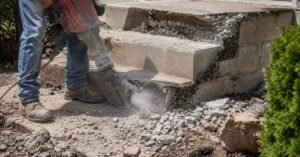
The best way to break up concrete depends on the slab’s thickness, reinforcement, size, location, and access. A small, unreinforced section may respond to hand tools, while thick or reinforced concrete usually requires powered equipment and careful planning.
Concrete can be heavy, sharp, dusty, and difficult to control once it starts cracking. Choosing the right approach helps reduce unnecessary damage to nearby surfaces while making cleanup and hauling much easier.
How Do You Choose the Right Concrete-Breaking Method?
The right method starts with assessing the concrete rather than immediately reaching for the biggest tool. Check the thickness, look for visible reinforcement, inspect the surrounding area, and determine how broken pieces will be removed.
For homeowners in Santa Fe, TX, planning is especially important when concrete is close to landscaping, fences, garages, foundations, or narrow access points. The goal is controlled removal rather than simply creating as much force as possible.
For broader demolition planning and timing considerations, see Mouton’s concrete demolition and haul-off guide for additional project-planning information.
What Is the Best Way to Break Up Concrete?
The best way to break up concrete is to match the removal tool and technique to the concrete’s thickness, reinforcement, size, and surroundings. Small unreinforced sections can sometimes be handled with a sledgehammer and pry bar, while thick or reinforced slabs generally require a jackhammer, breaker, saw, or other professional equipment.
Starting with an assessment helps prevent wasted effort and reduces the chance of damaging nearby structures.
Match the Tool to the Concrete
Different tools work best for different situations:
- Sledgehammer: Useful for smaller, thinner sections.
- Rotary hammer: Helpful for controlled breaking and smaller demolition work.
- Jackhammer: Effective for thicker slabs and larger areas.
- Hydraulic breaker: Better suited to substantial reinforced concrete and heavy demolition.
- Concrete saw: Useful when controlled cuts are needed before breaking.
- Pry bar: Helps separate and lift loosened pieces.
Using an oversized machine in a tight residential area can create unnecessary vibration and access problems. Likewise, using hand tools on a thick reinforced slab can turn a manageable project into exhausting, slow work.
Which Concrete Breaking Methods Work Best for Thick or Reinforced Slabs?
Breaking thick concrete requires more planning because thickness and reinforcement increase the force needed to create controlled fractures. A professional may combine saw cutting, powered breakers, and mechanical removal instead of relying on one tool. Reinforcing steel may also need to be separated before the broken sections can be safely lifted and hauled away.
Reinforced concrete containing rebar or wire mesh behaves differently from an unreinforced slab. Before demolition, identify reinforcement and consider what is underneath and around the concrete.
This is also where professional concrete demolition techniques can provide an advantage. The objective is not just to crack the slab but to create manageable pieces that can be removed without unnecessary impact on the property.
For information about related demolition services, visit Mouton Concrete Services.
How Can You Break Concrete Without Damaging Nearby Property?
Concrete removal becomes more complicated when the slab sits beside a house, driveway, retaining feature, utility line, fence, or landscaped area. Controlled cuts and smaller breaking zones can help limit vibration and prevent damage from uncontrolled cracking.
Before starting, clear the work zone and identify potential hazards. If underground utilities may be present, do not assume their location based on visible features. Utility identification and professional assessment should come before aggressive demolition.
Dust and flying fragments are also important concerns. Safety glasses, hearing protection, gloves, suitable footwear, and appropriate dust-control practices can reduce common demolition hazards.
For tight spaces, slower and more controlled concrete breaking methods may produce a better result than using maximum force.
What Steps Make Concrete Removal Safer and More Efficient?
A practical removal process should follow a clear sequence instead of attacking the concrete randomly.
1. Inspect the Work Area
Determine the concrete’s approximate thickness, reinforcement, size, condition, and surrounding structures. Check access for workers, tools, equipment, and debris removal.
2. Prepare the Site
Remove furniture, vehicles, loose items, and unnecessary obstacles. Establish a controlled work zone and protect surfaces that will remain.
3. Select the Breaking Technique
Choose hand tools, powered breakers, saw cutting, or heavier equipment according to the project’s size and conditions. Avoid using a method simply because it is available.
4. Break the Concrete Into Manageable Sections
Work systematically so pieces can be lifted or mechanically moved safely. Smaller pieces are generally easier to handle than large uncontrolled sections.
5. Separate Reinforcement
If rebar or wire mesh is exposed, it may need to be cut or separated using the appropriate equipment. Do not attempt to force reinforced sections apart without understanding how they are supported.
6. Load and Remove Debris
Broken concrete is extremely heavy. Plan the hauling method before demolition begins so debris does not remain scattered around the property.
7. Clean and Inspect the Area
Remove loose fragments and dust, then inspect the remaining surface and surrounding structures for damage before beginning the next phase of construction.
When Should You Avoid DIY Concrete Breaking?
DIY removal may be reasonable for a small, accessible, unreinforced section when the person doing the work has the appropriate tools and understands the hazards. However, a professional approach becomes more appropriate as the size, thickness, reinforcement, or surrounding risks increase.
Consider professional help when:
- The concrete is heavily reinforced.
- The slab is unusually thick.
- The area is large.
- Heavy equipment is required.
- Concrete sits close to a building or foundation.
- Access is restricted.
- Underground utilities may be nearby.
- You need demolition and debris removal coordinated together.
A professional can also evaluate whether how to break concrete questions are better answered with mechanical breaking, cutting, or another controlled method.
How Can Santa Fe Homeowners Plan Concrete Removal Correctly?
Local conditions can affect access, equipment placement, hauling, and project preparation. In Santa Fe, TX, homeowners may need to consider narrow residential access, nearby landscaping, existing driveways, and the location of surrounding structures before demolition starts.
Mouton Concrete Services lists its address as 6803 Avenue F, Santa Fe, TX 77510 and serves the Santa Fe area. Its published working hours are Monday through Friday, 8:00 AM–5:00 PM, and Saturday and Sunday, 9:00 AM–5:00 PM.
For a project assessment or quote, call (409) 692-1638 to discuss your concrete removal needs.
Get Professional Concrete Removal
What Should You Do After the Concrete Is Broken?
Breaking the slab is only part of the project. The remaining concrete pieces must be safely collected, loaded, transported, and properly disposed of or recycled where appropriate.
The site should then be checked for loose fragments, exposed reinforcement, uneven ground, and damage to surrounding areas. If a new driveway, patio, walkway, or other surface will be installed, proper preparation of the remaining base is important.
Good planning also prevents a common problem: finishing the demolition but having no practical plan for the resulting debris.
Why Is a Planned Approach Better Than Simply Using More Force?
More force does not always mean faster removal. Excessive impact can increase vibration, create larger and heavier debris pieces, and raise the possibility of damaging nearby structures.
A controlled process uses the right equipment, breaks concrete into manageable sections, accounts for reinforcement, and keeps debris removal organized. This approach can make the work safer and easier to manage from the first break through final cleanup.
For Santa Fe property owners who need a practical approach to concrete demolition, Mouton Concrete Services can be considered when professional assistance is the better option.
Frequently Asked Questions
What is the easiest way to break up a small concrete slab?
For a small, relatively thin and unreinforced slab, a sledgehammer, pry bar, and proper protective equipment may be sufficient. The slab should be assessed first, and the work area should be cleared. If the concrete is reinforced, unusually thick, or close to structures, powered equipment or professional demolition may be more appropriate.
How long does concrete breaking usually take?
The time depends on the slab’s size, thickness, reinforcement, access, equipment, and debris volume. A small patio or sidewalk can be much quicker to remove than a reinforced driveway or foundation. Weather and site conditions can also affect progress, so an exact timeframe should be determined after assessing the specific project.
Does thicker concrete require special equipment?
Often, yes. Thick or reinforced concrete can require a jackhammer, hydraulic breaker, concrete saw, or other heavy-duty equipment. The correct choice depends on the structure and surroundings. Trying to remove substantial reinforced concrete with basic hand tools can make the work unnecessarily slow and physically demanding.
Can concrete be broken without damaging nearby structures?
It can be, but the risk depends on the location and demolition method. Controlled cutting and smaller breaking sections can help when concrete is near buildings, landscaping, fences, or other surfaces. Proper planning, equipment selection, and utility awareness are important when the surrounding property must remain intact.
What factors affect the cost of concrete removal?
Project size, concrete thickness, reinforcement, site access, equipment needs, labor, loading, hauling, and disposal can all affect the total cost. A small accessible slab generally requires fewer resources than a large reinforced structure. A contractor can provide a more useful estimate after reviewing the actual site conditions.
Does concrete demolition include debris removal?
It depends on the contractor and service agreement. Some demolition services can coordinate breaking, loading, hauling, and disposal as part of the project. Confirm what is included before work begins so you know whether broken concrete will be removed from the property or left for separate disposal.
Why choose professional concrete demolition services?
Professional demolition can be useful when concrete is thick, reinforced, extensive, difficult to access, or located near sensitive structures. Experienced crews can select appropriate equipment, organize the breaking process, manage heavy debris, and reduce unnecessary disruption compared with attempting a complex demolition project without suitable equipment.