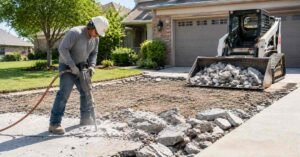
Choosing the right concrete demolition tools can make a major difference in how safely and efficiently a slab, driveway, walkway, or other concrete surface is removed. The best option depends on the concrete thickness, reinforcement, work area, access, and amount of material that needs to be broken.
For property owners in Santa Fe and nearby Galveston County communities, understanding the equipment used during demolition can also help you ask better questions before work begins. Professional crews use different tools for breaking, cutting, separating, loading, and hauling concrete rather than relying on one machine for every project.
Which Concrete Demolition Tools Work Best for Different Projects?
The best equipment depends on the size and condition of the concrete. Handheld tools can work for small sections, while powered breakers, saws, and heavy machinery are better suited to thick slabs and larger removal projects. Choosing equipment based on the job improves control, productivity, and worker safety.
Sledgehammers and Chisels for Small Sections
Sledgehammers and masonry chisels are useful when only a small amount of concrete needs to be removed. They provide direct control and can be practical around areas where larger machines cannot safely operate.
These tools are generally better for limited repairs or small slabs than extensive demolition.
Jackhammers for Controlled Breaking
Electric or pneumatic jackhammers provide considerably more breaking power than manual tools. They are useful for driveways, patios, walkways, and sections of thicker concrete.
Operators can use different bits depending on whether the goal is to fracture, chip, or remove material. Proper handling is important because vibration, flying fragments, and dust can create safety hazards.
Concrete Saws for Precise Cuts
Concrete cutting tools are valuable when a clean separation is needed before breaking the slab. Saw cuts can divide a large surface into smaller sections that are easier to control, lift, and remove.
This approach can also help limit unnecessary damage to concrete that will remain in place.
Hydraulic Breakers and Heavy Equipment
For substantial slabs or reinforced concrete, hydraulic breakers attached to excavators or other compatible equipment can provide the impact force required for efficient removal.
Other machines may assist with lifting, loading, crushing, and hauling broken material. The goal is not simply to use the biggest machine available but to select equipment that matches the site and demolition requirements.
How Should You Choose Concrete Demolition Tools for a Safe Job?
The right selection starts with the concrete itself and the conditions around it. Before demolition, evaluate slab thickness, reinforcement, access, nearby structures, utilities, and the amount of material to remove. This determines whether handheld equipment, powered breakers, saws, or larger machinery will provide the safest and most efficient approach.
Check Thickness and Reinforcement
Thin residential concrete may require less aggressive equipment than a thick reinforced slab. Rebar or wire mesh can also change the demolition process because breaking concrete and separating steel are different tasks.
Heavy duty demolition tools may be necessary when reinforced concrete cannot be efficiently handled with handheld equipment.
Consider Access and Surrounding Property
Equipment selection should account for gates, driveways, landscaping, fences, walls, sidewalks, and overhead obstacles. A large machine may have excellent power but still be unsuitable if the work area is confined.
A professional assessment helps determine how equipment can enter the property, where debris can be placed, and how surrounding surfaces can be protected.
What Makes Concrete Chipping Tools Safer and More Efficient?
Concrete chipping tools work best when demolition is performed in manageable sections rather than attacking an entire slab without a plan. Breaking concrete strategically helps control debris size, reduces unnecessary vibration, and makes removal easier.
Before work starts, the area should be cleared of vehicles, furniture, plants, and other movable items. Nearby utilities should also be identified before powered equipment begins breaking the surface.
Mouton Concrete Services’ existing driveway demolition guidance emphasizes preparation, utility awareness, protective barriers, dust control, and proper equipment selection.
For more background on preparing a demolition project safely, see safe concrete demolition.
Which Concrete Demolition Equipment Helps Control Dust and Debris?
Breaking concrete produces dust, sharp fragments, and heavy debris. Good equipment selection should therefore be paired with practical site controls.
Water can help suppress airborne dust during appropriate cutting or breaking operations. Barriers and protective coverings can help shield nearby windows, landscaping, fences, and other vulnerable surfaces.
Once the concrete has been broken, the debris needs to be moved and disposed of properly. Depending on the project, material may be loaded for hauling or directed toward suitable recycling or reuse channels.
Mouton Concrete Services states that its demolition service includes safe debris removal and haul-off, helping leave the work area prepared for the next stage.
What Is the Safest Process for Using Concrete Demolition Tools?
Safe demolition is more than choosing powerful equipment. A structured process reduces avoidable risks and keeps the work organized.
- Inspect the site: Review the slab, surrounding structures, access points, and visible hazards.
- Identify utilities: Locate relevant underground or nearby utility lines before breaking concrete.
- Prepare the area: Remove movable objects and establish a controlled work zone.
- Select equipment: Match the breaker, saw, chisel, or machinery to the concrete and site.
- Cut or break strategically: Divide larger sections when appropriate instead of creating uncontrolled fractures.
- Separate reinforcement: Handle exposed rebar or mesh with suitable equipment and safe procedures.
- Load and remove debris: Keep broken concrete organized so it can be safely transported.
- Inspect the surface: Check the remaining area for hazards and prepare it for the next construction phase.
Personal protective equipment, clear communication, trained equipment operation, and controlled access are essential throughout the process.
How Can the Right Equipment Reduce Demolition Costs?
Equipment can affect labor time, productivity, debris handling, and the overall scope of a demolition project. However, the most expensive machine is not automatically the most economical choice.
For a small project, renting or operating oversized equipment may create unnecessary costs. For a large or reinforced slab, relying on manual labor alone may increase project time and labor demands.
Pricing also depends on factors such as concrete thickness, total area, reinforcement, site accessibility, hauling requirements, and the amount of preparation needed. A site-specific estimate is more useful than relying on a generic price per square foot.
When Should You Hire a Professional Concrete Demolition Crew?
Professional help makes sense when the concrete is thick, reinforced, difficult to access, close to structures, or too large for practical DIY removal. Specialized equipment can also make a major difference when the project involves substantial debris or requires careful protection of nearby property.
Mouton Concrete Services reports more than 40 years of experience and serves locations within 20 miles of its Santa Fe base. Its listed working hours are Monday through Friday, 8:00 AM–5:00 PM, and Saturday through Sunday, 9:00 AM–5:00 PM.
The company lists its address as 6803 Avenue F, Santa Fe, TX 77510, with phone contact at (409) 692-1638.
For projects involving old or damaged concrete, the right equipment and removal plan can reduce unnecessary damage while preparing the property for replacement, remodeling, or other use.
Explore Concrete Demolition & Removal Services to discuss the next step for your concrete removal project.
How Does Tool Selection Affect the Final Removal Result?
Effective demolition is measured by more than how quickly concrete breaks. The final result should leave the work area safe, accessible, and ready for whatever comes next.
A carefully selected combination of breaking, cutting, lifting, and hauling equipment can make removal more controlled. It can also reduce unnecessary damage to surrounding areas and simplify debris management.
If the project involves a driveway, you can also review these concrete driveway demolition tips before planning the work.
For Santa Fe property owners, the key is to match the equipment to the actual site rather than choosing a tool based only on power. The right concrete demolition tools support safer breaking, cleaner removal, and better preparation for the next phase. For local assistance, contact Mouton Concrete Services.
Frequently Asked Questions
What factors affect the cost of concrete demolition?
Concrete demolition pricing can vary based on slab size, thickness, reinforcement, accessibility, equipment requirements, labor, and debris hauling. A small unreinforced patio may require very different resources from a thick reinforced driveway. The most reliable way to understand project cost is to have the site assessed and receive a project-specific estimate.
How long does concrete demolition usually take?
The timeline depends on the size and thickness of the concrete, reinforcement, site access, equipment, and debris volume. A small section may be completed relatively quickly, while larger or reinforced surfaces require more breaking, loading, and hauling. A site assessment provides a more accurate project schedule than a general time estimate.
What is included in concrete demolition and removal?
The scope can include planning, breaking or cutting concrete, separating material, loading debris, hauling it away, and preparing the cleared surface. The exact work depends on the project. Mouton Concrete Services states that its demolition and removal service includes concrete demolition, removal, haul-off, driveway replacement, and surface preparation.
Can concrete demolition be handled urgently?
Urgent handling depends on crew availability and the specific circumstances of the project. Do not assume a same-day response unless the company confirms it. If damaged or unsafe concrete requires prompt attention and explain the situation so the appropriate next step can be discussed.
Why should homeowners use professional demolition equipment?
Professional equipment can provide more controlled breaking and faster material handling than basic hand tools, particularly for thick or reinforced concrete. Professional crews also understand how to protect surrounding areas, manage debris, and prepare the remaining surface. This can reduce avoidable property damage and make the overall removal process more manageable.
What should I do before a demolition crew arrives?
Clear vehicles, furniture, plants, and other movable items from the work zone when possible. Keep children and pets away from the area and inform the crew about known access restrictions or concerns around the property. Existing guidance also recommends identifying nearby utilities and protecting surrounding surfaces before demolition begins.