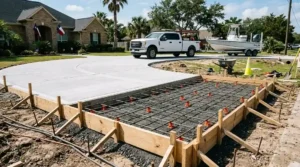
When homeowners in Galveston County and the Greater Houston area start collecting quotes for a new driveway, they almost always notice a big price gap between the lowest bid and the most thorough estimate. Nine times out of ten, that price difference comes down to two things you cannot see once the concrete dries: how thick the slab is poured and what kind of steel reinforcement is sitting inside it.
A standard 4-inch concrete driveway was originally designed for 3,500-pound family sedans and light crossovers. But here in Southeast Texas where households routinely park three-quarter-ton crew-cab pickups, dually welding rigs, 24-foot bay boats, and fifth-wheel RVs over shifting coastal clay picking the wrong slab thickness is the fastest way to end up with snapped corners and sunken tire ruts.
Below, Mike Mouton, owner of Mouton Concrete Services in Santa Fe, TX, breaks down the real-world structural difference between a 4-inch, 5-inch, and 6-inch concrete driveway so you can choose the right specification before a single form board is staked into your yard.
Why 1 or 2 Extra Inches of Concrete Multiplies Load Capacity (It’s Not Just 50% Stronger)
Many homeowners assume that stepping up from a 4-inch slab to a 6-inch slab simply makes the driveway 50% stronger because it uses 50% more concrete. In structural engineering, flexural strength (the slab’s ability to resist bending and snapping under a tire load) actually increases exponentially with thickness:
- A true 4-inch concrete slab safely handles passenger cars, mid-size SUVs, and standard half-ton pickups (up to roughly 6,000–7,000 lbs gross weight) when poured over a properly compacted base with chaired steel rebar.
- A 5-inch concrete slab increases bending resistance by roughly 55% over a 4-inch pour, making it the ideal sweet spot for heavy 3/4-ton and 1-ton pickups (F-250, Ram 2500, Silverado 2500HD), tandem-axle boat trailers, and loaded utility trailers.
- A 6-inch concrete slab delivers more than double the load-carrying capacity of a 4-inch slab. It is engineered to resist point-load shearing from Class A and Class C motorhomes, fifth-wheel tongue jacks, dually welding rigs, commercial box trucks, and roll-off dumpsters.
When Is a 4-Inch Concrete Driveway Enough?
A 4-inch driveway is still the residential standard across most HOA subdivisions when your daily vehicles are sedans, crossovers, half-ton trucks, and golf carts. However, there is a massive difference between a “builder-grade 4-inch slab” and a true, full-depth 4-inch slab.
Many cut-rate crews stake up nominal 2×4 lumber forms (which actually measure only 3.5 inches tall) and leave high spots of dirt inside the middle of the frame meaning parts of the driveway are barely 2.5 to 3 inches thick! Even worse, when builders pour subdivision driveways in communities like League City, TX or Friendswood, TX, they often fail to compact the utility trenches outside the garage door, causing the top panels to sink two inches below the garage slab lip.
Our Rule for 4-Inch Driveways: If your household only parks standard passenger vehicles and half-ton trucks, a true 4-inch pour will serve you well for decades provided the topsoil is excavated, a compacted base cushion is installed, and deformed steel rebar is tied on support chairs in the center of the slab.
When You Should Upgrade to a 5-Inch or 6-Inch Driveway (3 Real Local Scenarios)
Adding an extra inch or two of ready-mix concrete during the initial pour only increases your total project budget by a modest percentage (you can compare baseline square-foot pricing in our guide on the cost to pour a concrete slab), because the excavation, forming, and finishing labor is already on site. Here are the three situations where upgrading to 5 or 6 inches pays for itself many times over:
1. Heavy Work Trucks, Welding Rigs & Dually Pickups
A loaded diesel crew-cab pickup with a steel service bed, welding machine, or toolboxes easily weighs 9,500 to 13,000 pounds and most of that weight rests right over the rear axle. When we build double-wide driveways and work-rig parking pads for homeowners in Pasadena, TX and Alvin, TX, we recommend a 5-inch or 6-inch slab reinforced with a tight steel rebar grid so turning tires never shear off the outer edges of the concrete.
2. Fifth-Wheel RVs, Travel Trailers & Offshore Boat Trailers
Trailers create a completely different kind of stress than a four-wheeled car: concentrated point loads. When you unhook a fifth-wheel camper or a 26-foot center-console bay boat on a tandem-axle trailer, thousands of pounds of downward force are concentrated onto two small leveling jacks or a single tongue wheel. On bayside and unincorporated properties in Bacliff, TX, Texas City, TX, and Santa Fe, pouring a 5-to-6-inch RV and boat pad prevents jack feet from punching cracks straight through the slab.
3. Street Culvert Crossings & Roadside Ditch Approaches
Even on a standard residential driveway, the last 6 to 10 feet where your driveway meets the street gutter or crosses an open roadside ditch culvert takes the hardest impact. Every time a delivery truck, garbage truck, or trailer turns off the road onto your apron, the tires hit the slab edge at an angle. Even when the main body of a residential driveway is poured at 4 or 5 inches, we thicken the street approach and culvert edges to prevent corner blowouts.
Why Concrete Thickness Means Nothing Without Chaired Rebar & Base Prep
Here is the honest truth from decades of tearing out failed driveways across the Texas Gulf Coast: even a 6-inch concrete slab will crack if it is poured directly over grass and mud with no steel support.
Our coastal Beaumont and black gumbo clay soils expand like a wet sponge during heavy Gulf rainstorms and shrink during late-summer heatwaves. When soil shrinks away from the underside of a driveway, the concrete slab has to act like a structural bridge over those low spots. Concrete by itself has tremendous compressive strength (resistance to crushing), but very low tensile strength (resistance to stretching and bending).
That is why every concrete driveway installation by Mouton Concrete Services pairs your chosen slab thickness with three non-negotiable structural steps:
- Full Sod & Root Excavation + Compacted Base: We strip away organic topsoil and compact a stabilized sand/base cushion so the slab rests on an even subgrade.
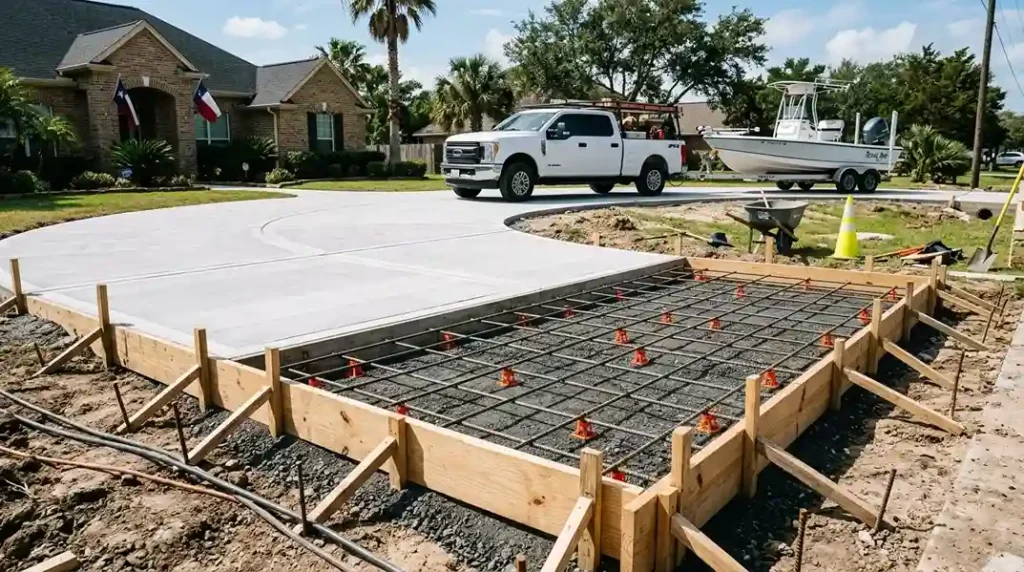
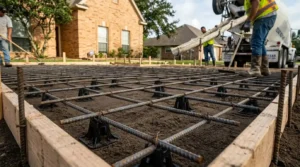
- Deformed Steel Rebar Tied on Support Chairs: We never use flimsy roll-out wire mesh that gets stepped down into the mud during the pour. We tie a grid of steel rebar elevated on chairs so the steel sits locked in the structural middle of the slab.
- Thickened Perimeter Edges & Timed Control Joints: By turning down the outer edges where tires drop off and cutting straight control joints at proper intervals, we keep your slab locked together season after season.
Quick Reference: Which Concrete Driveway Spec Fits Your Property?
| Vehicles & Use Case | Recommended Thickness | Reinforcement & Edge Spec |
|---|---|---|
| Passenger Cars, SUVs, Golf Carts & 1/2-Ton Pickups | True 4 Inches | Chaired Steel Rebar Grid + Thickened Street Apron |
| 3/4-Ton & 1-Ton Pickups, Bay Boat Trailers & Utility Trailers | 5 Inches | Chaired Steel Rebar (Tighter Grid) + Thickened Perimeter Edges |
| Fifth-Wheel RVs, Motorhomes, Dually Welding Rigs & Shop Drives | 6 Inches | Heavy Chaired Rebar Grid + Deepened Perimeter & Culvert Beams |
Get an Honest On-Site Driveway Assessment From Mike Mouton
Not sure whether your property calls for a 4-inch, 5-inch, or 6-inch pour or need an old, cracked driveway torn out and hauled off first? Based at 6803 Avenue F in Santa Fe, TX, Mike Mouton will walk your property in person, check your soil grade and drainage slope, ask what vehicles you plan to park on the slab, and give you a clear, written estimate with zero sales pressure.