Every week when we break out and haul away failed residential driveways across Galveston County and the Greater Houston area, our crew uncovers the exact same crime scene at the bottom of the rubble: a rusty sheet of thin, 6×6 welded wire mesh pressed flat into the dirt underneath the slab.
When the homeowner originally paid for that driveway five or six years earlier, the contractor promised them the slab would be “steel-reinforced.” Technically, there was steel inside the forms but because thin wire mesh was rolled out on the dirt and trampled down by rubber boots during the pour, it provided zero structural reinforcement when the underlying Texas clay shifted.
Before you sign an estimate for a new driveway or patio, here is what Mike Mouton, owner of Mouton Concrete Services in Santa Fe, TX, wants every homeowner to understand about the difference between rolled wire mesh and a chaired steel rebar grid.
Why Concrete Needs Steel in the First Place (Especially Over “Gumbo” Clay)
Concrete is a rock-hard material when you press straight down on it (high compressive strength), but it is surprisingly brittle when stretched or bent over an uneven surface (low tensile strength).
In parts of the country with stable rocky or sandy-loam subgrades, the ground underneath a driveway barely moves. Here on the Texas Gulf Coast from the heavy Fort Bend black “gumbo” clay in Fresno, TX to the expansive coastal Beaumont clay in Friendswood, TX and League City, TX the soil underneath your driveway is in constant motion:
- During Gulf Tropical Downpours: Clay soil absorbs water like a sponge and swells upward, pushing against the bottom of your concrete panels.
- During August & September Droughts: The outer 2 to 3 feet of soil along the grass edges of your driveway dries out and shrinks faster than the damp soil under the center of the slab, leaving the outer edges of your driveway hanging over thin air.
When a 6,500-pound pickup truck rolls over a section of driveway where the clay has shrunk away, the concrete bends downward. Without heavy steel tensile reinforcement suspended in the structural middle of the slab, the panel snaps and drops.
The “Pull-Up Hook” Myth: Why Welded Wire Mesh Almost Always Fails in Driveways
Standard 10-gauge or 6-gauge welded wire mesh (often sold in rolls at big-box hardware stores) is thin enough to bend by hand. Budget concrete crews love wire mesh because two workers can unroll it across a driveway frame in fifteen minutes for a fraction of the material and labor cost of tying steel rebar.
When homeowners ask how that flimsy mesh is going to stay in the middle of the concrete, low-bid contractors always give the same answer: “Don’t worry, we use a claw hook to pull the mesh up into the middle of the concrete as we pour.”
Here is what actually happens on pour day when a crew tries the “pull-up” trick:
- Four Workers Stand directly on the Mesh: As 4,000 pounds of wet ready-mix concrete pours down the chute, the crew has to walk directly across the forms to rake and screed the mud. Every footstep stomps the flexible wire mesh right back down into the dirt.
- Steel at the Bottom of the Slab Does Zero Work: When the mesh ends up resting on the subgrade at the very bottom of the pour, it has no leverage to stop the top or middle of the slab from cracking and pulling apart.
- Groundwater Rusts Exposed Bottom Mesh: Even worse, on coastal properties in Galveston, TX and Tiki Island, TX, wire mesh sitting against damp, salty soil corrodes rapidly and loses whatever thin cross-section it had within a few years.
How Chaired Deformed Steel Rebar Turns Your Driveway Into a Structural Bridge
Unlike thin wire mesh which is only meant to hold hairline surface shrinkage together on light indoor floors deformed steel rebar (#3 or #4 structural reinforcing bar) is solid, ridged carbon steel engineered to carry real structural tension.
1. Mechanical Grip From Deformed Ridges
Wire mesh is made of smooth wire, meaning cured concrete can slide along the wire once a crack forms. Structural rebar is rolled with raised ribs (“deformations”) along its entire length that mechanically lock into the hardened concrete so the two materials move as a single unit.
2. Elevated on Rebar Support Chairs Before the Truck Arrives
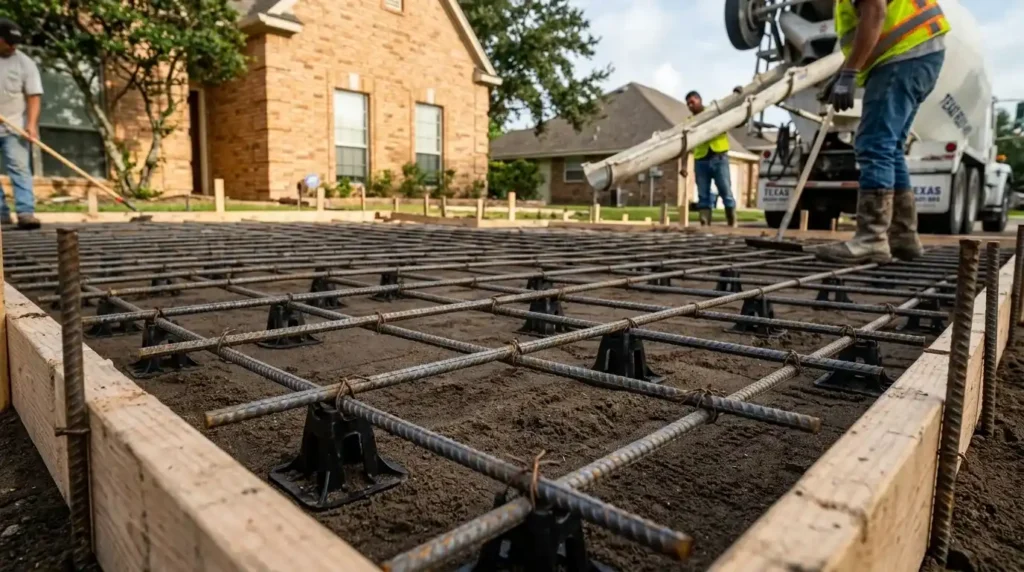
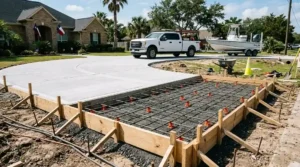
At Mouton Concrete Services, we hand-tie our steel rebar into a rigid grid at regular on-center intervals and snap rebar support chairs underneath the intersections before a single drop of concrete enters the forms. Whether we are pouring a 4-inch, 5-inch, or 6-inch concrete driveway, those chairs physically hold the steel grid 2 inches off the compacted sand base. Even when our crew walks directly on top of the rebar grid during the pour, the steel never touches the dirt.
<H3>
3. Stopping Vertical “Heave and Drop” (Differential Displacement)
All concrete in Texas will eventually experience minor hairline curing tension (which we guide cleanly into straight control joints). The real test of reinforcement is whether two adjacent driveway sections stay flush and level with each other ten years later. A chaired steel rebar grid acts like steel dowels across the entire mat, preventing one side of a joint from dropping an inch lower than the other.
Head-to-Head Comparison: Chaired Steel Rebar vs. Rolled Wire Mesh
| Feature | Chaired Steel Rebar Grid (Our Standard) | Rolled Welded Wire Mesh (Low-Bid Shortcut) |
|---|---|---|
| Position During Pour | Locked in the structural center of the slab on rigid support chairs | Almost always stepped down into the mud at the bottom of the slab |
| Surface Bond to Concrete | Raised deformed steel ribs lock mechanically into cured concrete | Smooth thin wire slips easily once a crack opens |
| Performance on Texas Clay | Bridges across dry-weather soil shrinkage voids without snapping | Snaps under pickup truck axles when clay shrinks at slab edges |
| Impact on Total Budget | Modest upfront material investment that adds 15–20+ years of life | Saves a few hundred dollars upfront; leads to full tear-out later |
Want to see how reinforcement and base prep fit into overall project pricing? Check out our breakdown on the cost to pour a concrete slab in the Greater Houston and Galveston County area.
3 Questions to Ask Any Concrete Contractor Before You Hire Them
Before you put down a deposit on a new driveway, patio, or workshop slab, ask the estimator these three simple questions and make sure their answers are written right on the contract:
- “Are you using tied deformed steel rebar or rolled wire mesh?” (Always insist on deformed steel rebar for any driveway or load-bearing slab in Texas.)
- “Will the rebar grid be set on support chairs before the concrete truck arrives?” (If they say they “pull it up during the pour,” walk away.)
- “Can I inspect the excavated base and chaired rebar grid before you pour?” (At Mouton Concrete Services, we are proud to show homeowners our form layout, compacted base cushion, and chaired rebar grid before a single yard of concrete is poured.)
Get a Free Estimate on a Properly Reinforced Driveway or Slab
If you are tired of looking at a cracked, sunken wire-mesh driveway and want a replacement built the right way with chaired steel rebar and proper base compaction, call Mike Mouton at Mouton Concrete Services. Based at 6803 Avenue F in Santa Fe, TX (77510), we serve homeowners and property owners across Galveston County and surrounding Gulf Coast communities.